
By Mrinal Talukdar
The numbers are out. And depending on who you are, they will either reassure you or quietly unsettle you.
Assam’s Total Fertility Rate, as recorded in NFHS-6, now stands at 1.6. Below the national average. Below replacement level. And if you do the arithmetic carefully — accounting for community-wise differences — the TFR of the Assamese-speaking population may be sitting somewhere around 1.2. That is not a number from the developing world. That is a number from Tokyo and Seoul.
The cradle is not just emptying. It may be disappearing altogether.
Twenty Years, One Long Slide
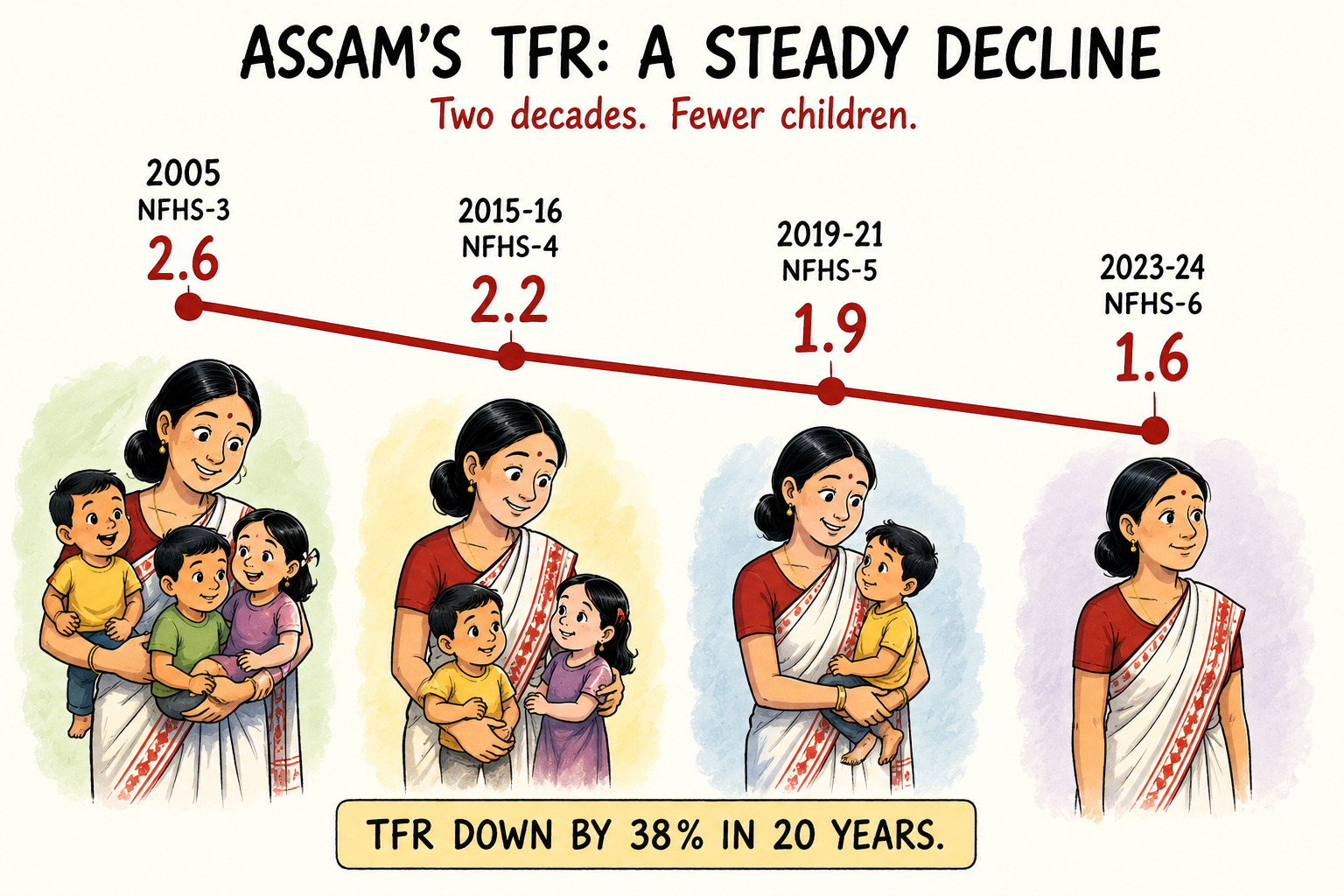
Go back to 2005. NFHS-3 put Assam’s TFR at 2.6. Families were larger then, especially in the villages. Rural Assam was at 2.8 — having three or four children was simply how life worked, tied to land, to labour, to the rhythms of a largely agricultural society. Urban Assam was already lower, around 1.8, but that was expected. Cities everywhere tend to shrink families.
A decade later, NFHS-4 showed 2.2 overall. The direction was clear. By NFHS-5, covering 2019 to 2021, the number had dropped to 1.9 — and for the first time in any survey, Assam had slipped below replacement level. Girls were staying in school longer. Contraception was more accessible. Young couples, especially in towns, were thinking differently about family size.
Then NFHS-6 arrived: 1.6 overall. Rural at 1.7. Urban at 1.2.
Across twenty years, the fertility rate has fallen by 38 percent. That is not a statistical blip. That is a society that has changed, fundamentally and perhaps permanently.
The Number Behind the Number
Here is where things get more complicated — and more important.
Assam’s Muslim population, concentrated largely in the char areas and river-belt districts of lower and central Assam, carries an estimated TFR of around 2.0. Still around replacement rate, though falling. Muslims make up roughly 34 percent of the state’s population.
If the overall state TFR is 1.6, and one major community sits at 2.0, then the weighted math for everyone else — the Assamese-speaking Hindus, the Bodo, Mising, Rabha and other communities who broadly identify with the Assamese cultural world — points to a TFR somewhere around 1.2.
Pause on that for a moment.
South Korea’s TFR is 0.72 — considered a national emergency. Japan is at 1.2 and has been throwing money at the problem for two decades with little success. Singapore is in the same boat. These are wealthy, industrialised nations with sophisticated welfare systems, and they cannot reverse the trend.
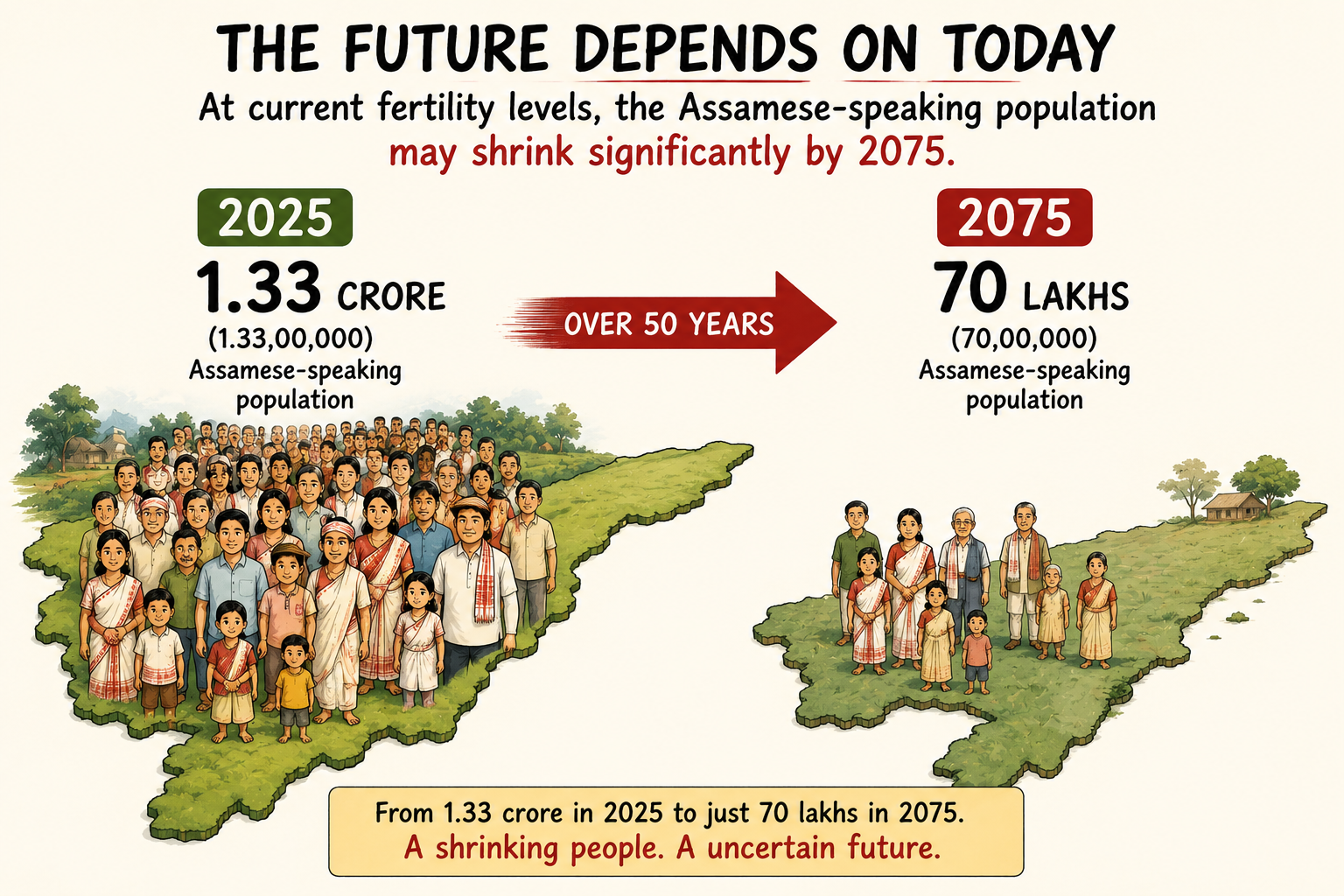
Assam’s Assamese-speaking population is roughly 1.3 crore today. At a sustained TFR of 1.2, that number could fall to under 70 lakhs by 2075. Not because of war or disease or migration out. Simply because not enough children are being born.
“There Is No Direct Answer”
Dr. Amit Chaudhury, Head of the Department of Statistics at Gauhati University, does not pretend otherwise. Asked about what a TFR of 1.2 means for Assam, he is careful, measured — as a statistician should be.
“There is no direct answer whether it is good or bad for having TFR at 1.2,” he says. “Population has to come down to be sustainable. But at the same time, Assam must guard itself socially and culturally — Assam will have a lesser younger force and more seniors. That will change the structure of society, and more caregivers will be needed.”
It is worth sitting with that for a moment. He is not saying this is a disaster. He is also not saying it is fine. He is saying it is complicated — and that the complication will show up not in graphs but in living rooms, in hospitals, in villages where the young have left and the old remain.
Two Things Are True at Once
The falling TFR is, in one reading, a genuine achievement.
It reflects decades of work by ASHA workers going door to door in remote villages, by school teachers who kept girls enrolled past Class Eight, by health programmes that made contraception accessible and destigmatised family planning. It reflects women making choices about their own bodies and futures. It reflects families deciding that one or two children, well-fed and well-schooled, are better than four children stretched thin.
From a purely economic standpoint, fewer people competing for the same resources — land, water, government services — is a good thing. Assam’s per capita figures improve. Pressure on forests and rivers eases.
All of that is real.
But so is this: the Assamese language is not just a way of talking. It is a civilisation. Srimanta Sankardeva built a philosophy, a theatre, a way of communal living around the naam-ghar that survives, in places, to this day. Bihu is not a festival in the tourism-brochure sense — it is a calendar, an emotional grammar, a way of marking time that belongs only here.
None of that survives automatically. It survives because people speak the language to their children, gather in naam-ghars, carry the gamosa not as a prop but as something that means something. When the population shrinks past a certain point, the cultural infrastructure hollows out — not overnight, but steadily, the way a river changes course.

The Ageing Problem Nobody Is Talking About
Dr. Chaudhury’s point about caregivers is one that deserves far more attention than it is currently getting.
A society with fewer young people and more elderly people is not just emotionally different — it is structurally different. The working-age population shrinks. The dependency ratio rises. Families that once had four adult children to look after two ageing parents now have one or two. The burden does not halve; in many ways, it concentrates.
Japan has built an entire industry around elderly care, robots included. It still struggles. In Assam, where joint family systems are weakening, where the young are moving to cities or other states, where formal social security for the elderly barely exists — the coming age imbalance will fall hardest on those least equipped to handle it.
Fifty Years From Now
By 2075, if things continue as they are, Assam will look quite different. The Assamese-speaking population will be smaller. The demographic weight of communities with higher fertility rates will have grown. Young Assamese professionals — and there are many talented ones — will continue leaving for Bengaluru, Delhi, abroad. Many will not come back. Each departure removes someone from the community’s reproductive future.
No government scheme reverses this quickly. The East Asian experience has shown that once a population settles into low-fertility habits, cash incentives and parental leave policies barely move the needle.
But two things could matter. One is cultural confidence — making young Assamese people feel that their language, their identity, their homeland is worth building a life in, not just visiting during Bihu. The other is practical investment in the language itself: in schools, in content, in digital spaces where Assamese feels alive and modern rather than museum-bound.
As Dr. Chaudhury suggests, there is no clean answer here. The falling fertility rate is the result of progress. It is also, depending on how you look at it, a slow emergency.
The NFHS-6 data is not a verdict. It is a warning with enough lead time to act on — if Assam chooses to.